Process of Coir Fiber

Collection
Fully ripened coconuts that have fallen naturally are collected from the ground.
Coconuts still on the tree are harvested either by skilled climbers or by using long bamboo poles with a knife attached to the end.
Husking
Ripe coconuts are husked immediately after harvesting.
Unripe coconuts are seasoned for about a month by spreading them in a single layer on the ground and keeping them dry.
Once seasoned and dried, coconuts are processed further for fibre extraction and product manufacturing.

Production story of Ediri Coco Products (Pvt) Ltd

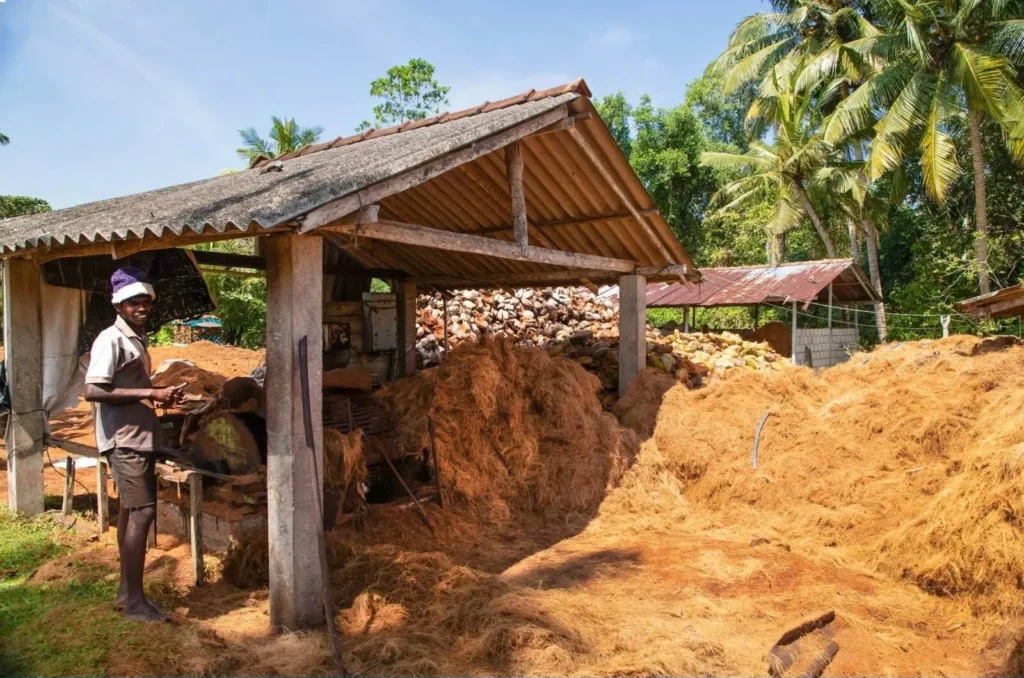
Ediri Coco Products ( Pvt) Ltd collects high-quality coconut husks from trusted local distributors. After collection, the husks undergo a process called retting — a natural curing stage where the husks are kept in an environment that encourages microbial activity. This process softens and partially decomposes the husk pulp, making it easier to separate the strong coir fibres from the soft coir pith. freshwater retting is done in large, cemented tanks built within the factory premises, ensuring a clean and controlled operation.
Once retting is complete, usually within seven to ten days, ripe husks are crushed and processed further. Immature husks, however, are dry milled without retting. These green husks are slightly moistened or soaked for one to two days before moving to the defibering stage, where fibres are extracted and prepared for production.
After the husks are fully retted, they become soft and easy to separate. The softened husks are then fed into a defibering machine, which beats and crushes them to loosen the fibers. As the machine rotates, the coir fibers separate from the pith and dust. Finally, the clean fibers come out through one side of the machine, ready for drying and further processing.
Coir fibre is generally classified in two main ways. The first classification depends on the maturity of the coconut husk from which it is obtained. Fully ripened coconuts produce brown coir, which is stronger, thicker, and more durable. In contrast, coconuts harvested before full maturity yield white coir, a lighter, softer, and finer type of fibre used for delicate applications.
The second classification is based on fibre length. Both brown and white coir contain fibres ranging from 10 to 30 centimeters. Fibres measuring 20 centimeters or more are known as bristle fibre, valued for their strength and stiffness. The shorter, finer fibres are known as mattress fibre, ideal for cushions, mattresses, and soft materials. On average, a 300- gram coconut husk can produce about 80 grams of coir fibre, with roughly one third being bristle fibre and the rest mattress fibre.
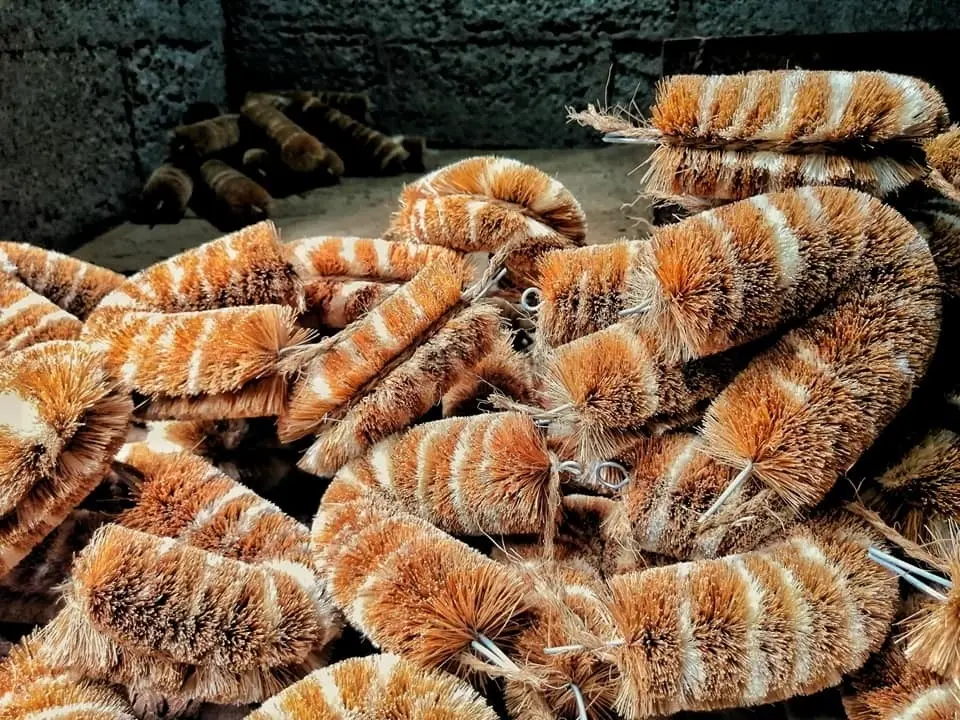
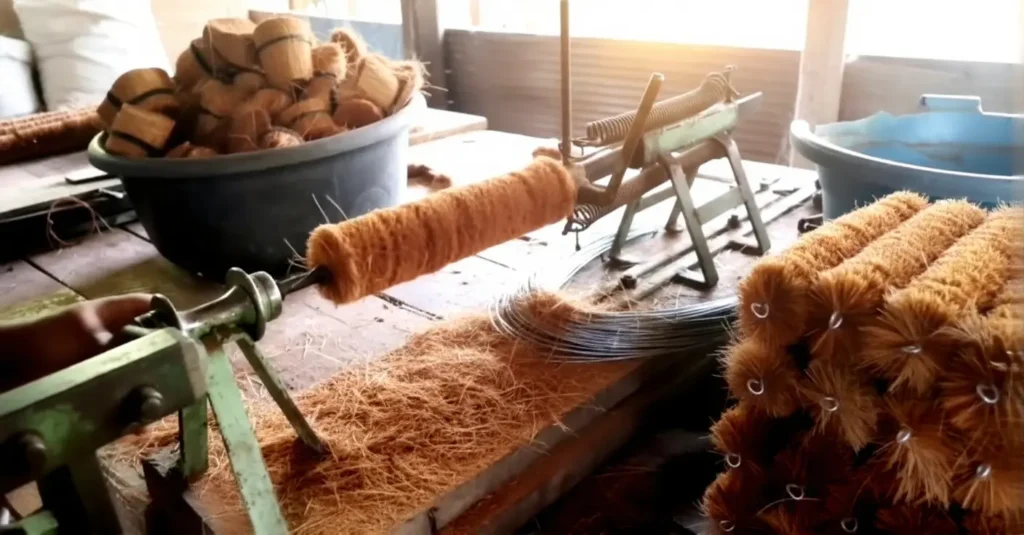
After collecting the separated fibers, they are cut to the required size using sharp-bladed equipment. The hand-twisted fibers are then shaped and assembled to form various coconut fiber products.
Coir fibre is generally classified in two main ways. The first classification depends on the maturity of the coconut husk from which it is obtained. Fully ripened coconuts produce brown coir, which is stronger, thicker, and more durable. In contrast, coconuts harvested before full maturity yield white coir, a lighter, softer, and finer type of fibre used for delicate applications.
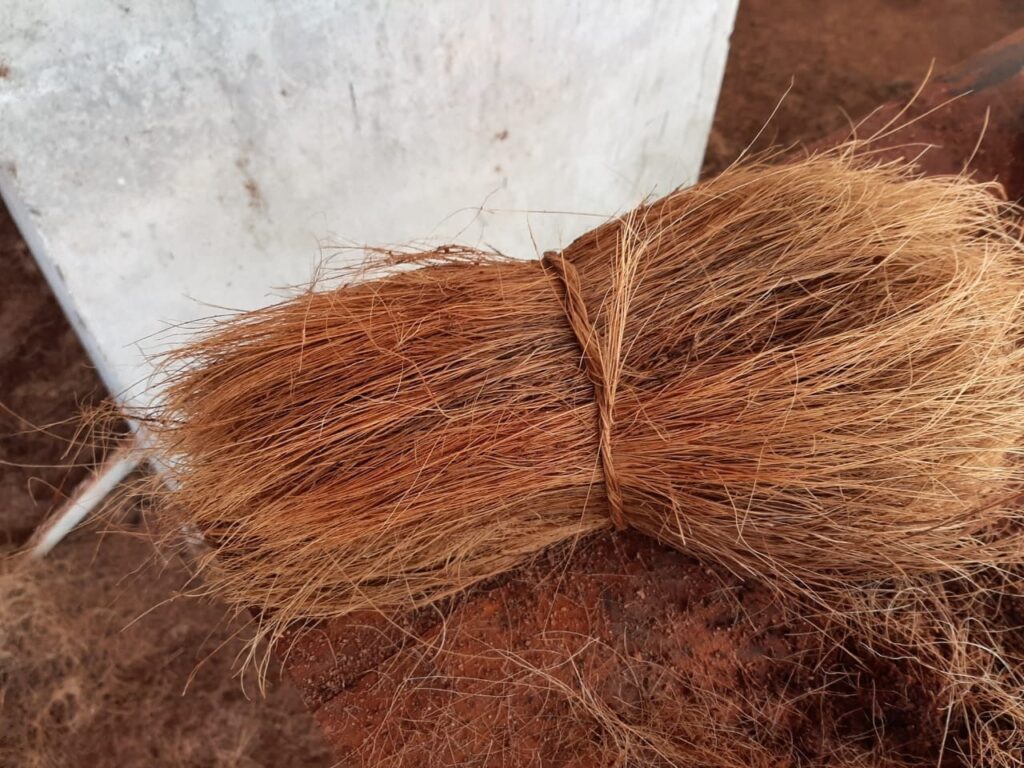
The second classification is based on fibre length. Both brown and white coir contain fibres ranging from 10 to 30 centimeters. Fibres measuring 20 centimeters or more are known as bristle fibre, valued for their strength and stiffness. The shorter, finer fibres are known as mattress fibre, ideal for cushions, mattresses, and soft materials. On average, a 300- gram coconut husk can produce about 80 grams of coir fibre, with roughly one third being bristle fibre and the rest mattress fibre.
After collecting the separated fibers, they are cut to the required size using sharp-bladed equipment. The hand-twisted fibers are then shaped and assembled to form various coconut fiber products.